celestx.
Spotting the clouds, before the storm
A multimodal AI system for early depression detection in Indonesian social media. IndoBERTweet reads the text, a Vision Transformer reads the images, and the two fuse into one clinical risk profile.
82.10%
accuracy · late fusion, 5-fold CV (294 pairs)
79.10%
F1-score · multimodal ViT fusion
13
false negatives · of 294 cases
SUS 80
usability score · 14 respondents (Excellent)
Demo · recorded run
See the dashboard run.
The real stack is FastAPI plus PyTorch on a local machine. Below is a recorded run, and the exported predictions to poke at. The model is not served publicly.
Exported posts
@sample-01
20 Apr 2026
Pada depresi, pola tidur bisa berubah jadi 2 arah hipersomnia (tidur berlebihan) & insomnia (susah tidur). Laki-laki lebih sering “withdraw” → tidur terus,. perempuan lebih “overthinking” → susah tidur. Tapi ini ga mutlak ya
DSM-5 category
Negative Mood
Suasana Hati Negatif
Matched keyword
"depresi"
First hit in the app's lexicon order
Tawarkan pendekatan empati personal, ajak komunikasi tanpa menghakimi.
Handles and avatars are masked, post text is unchanged. The archive only exports posts the model flagged, so every sample reads INDICATED.
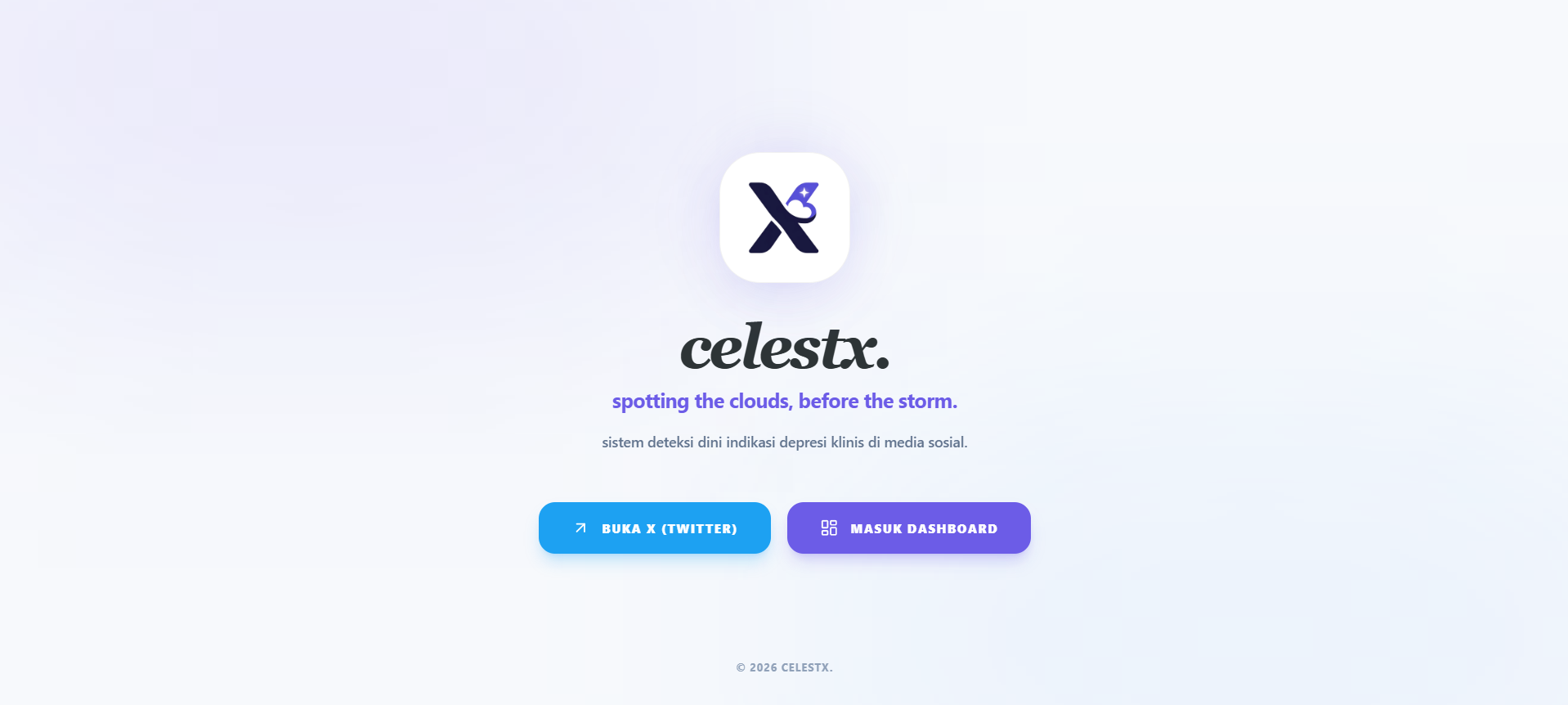
Landing Page
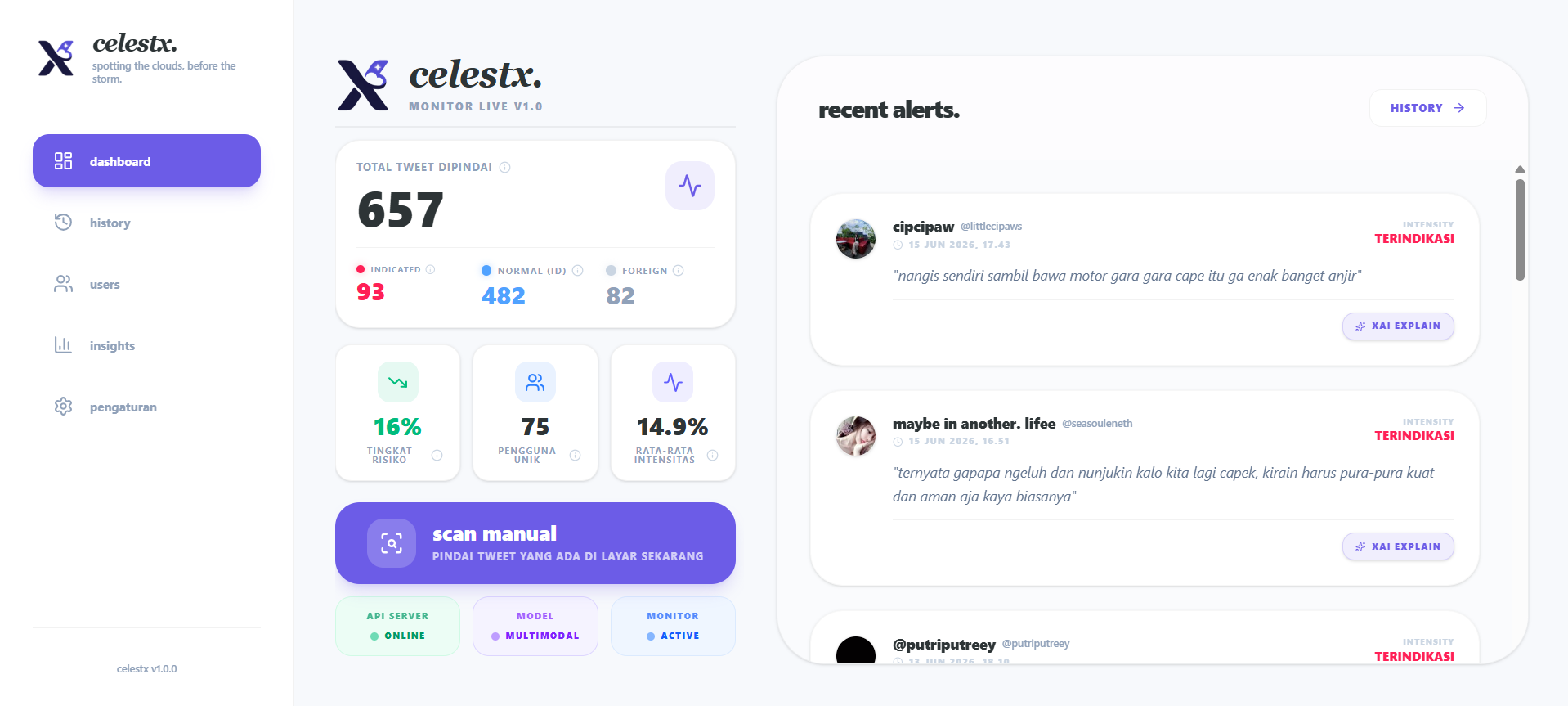
Dashboard
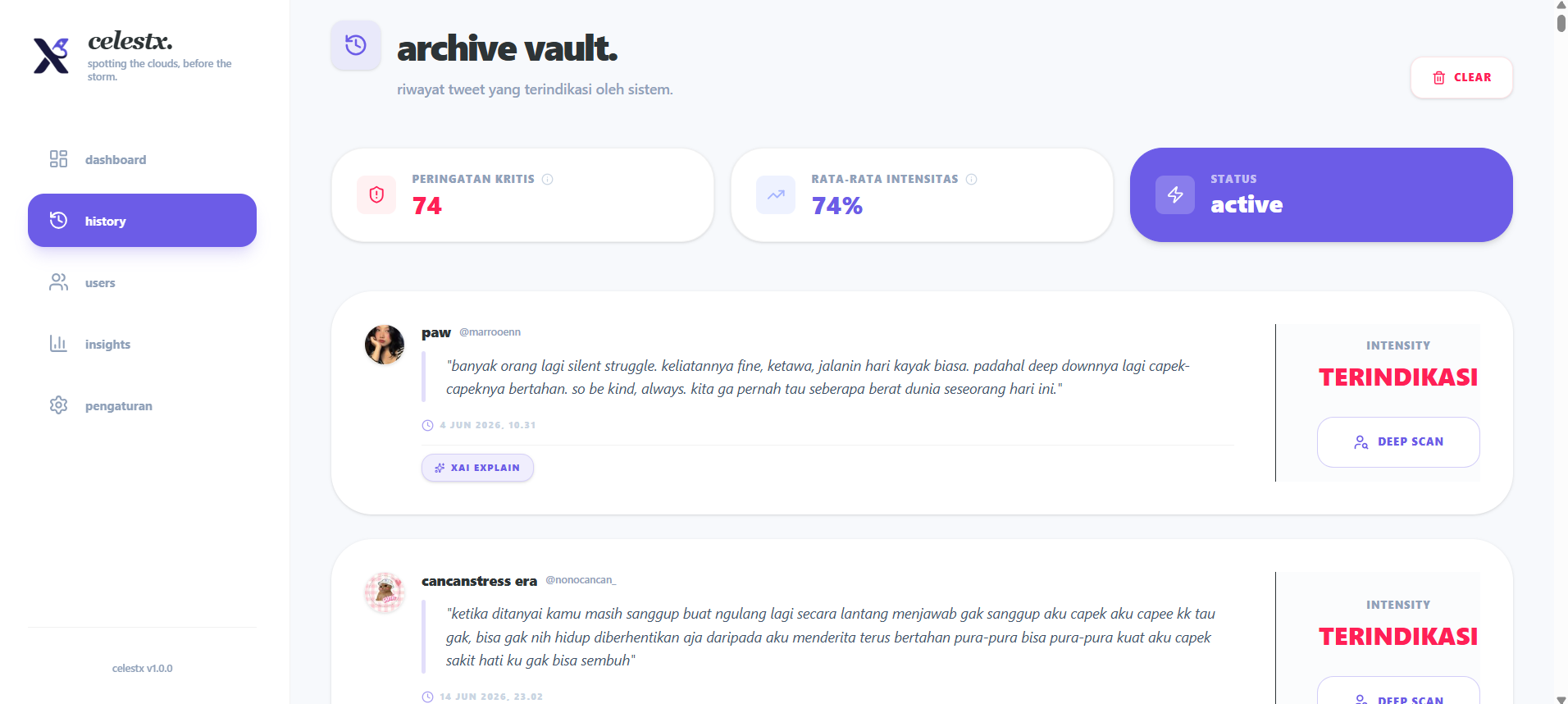
History Page
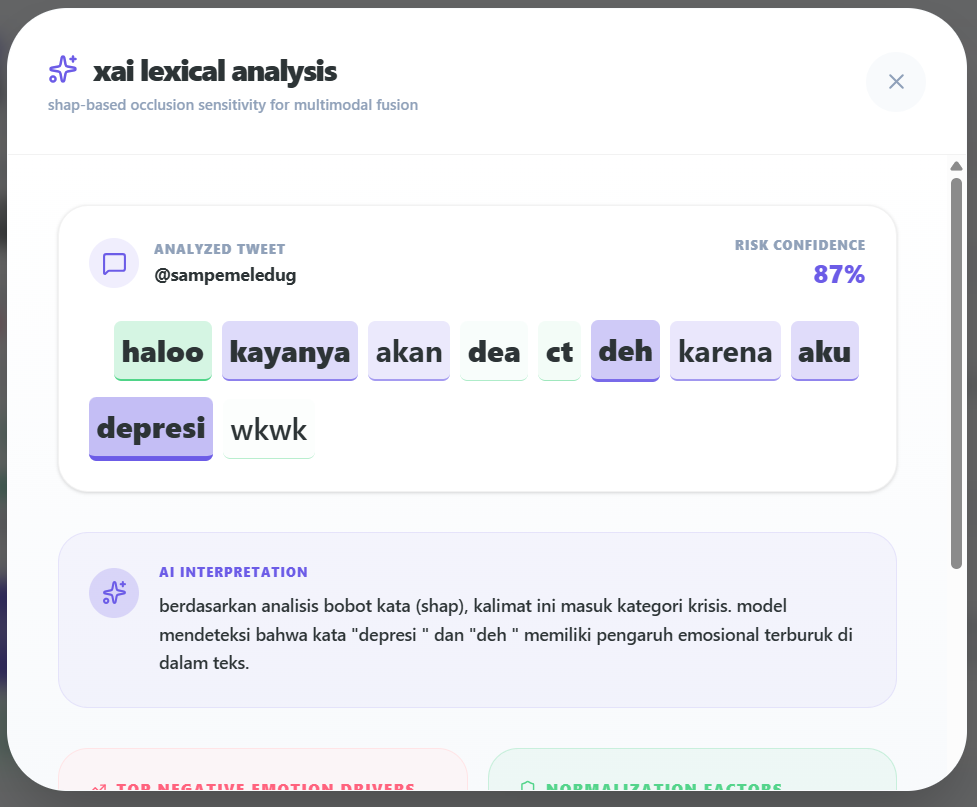
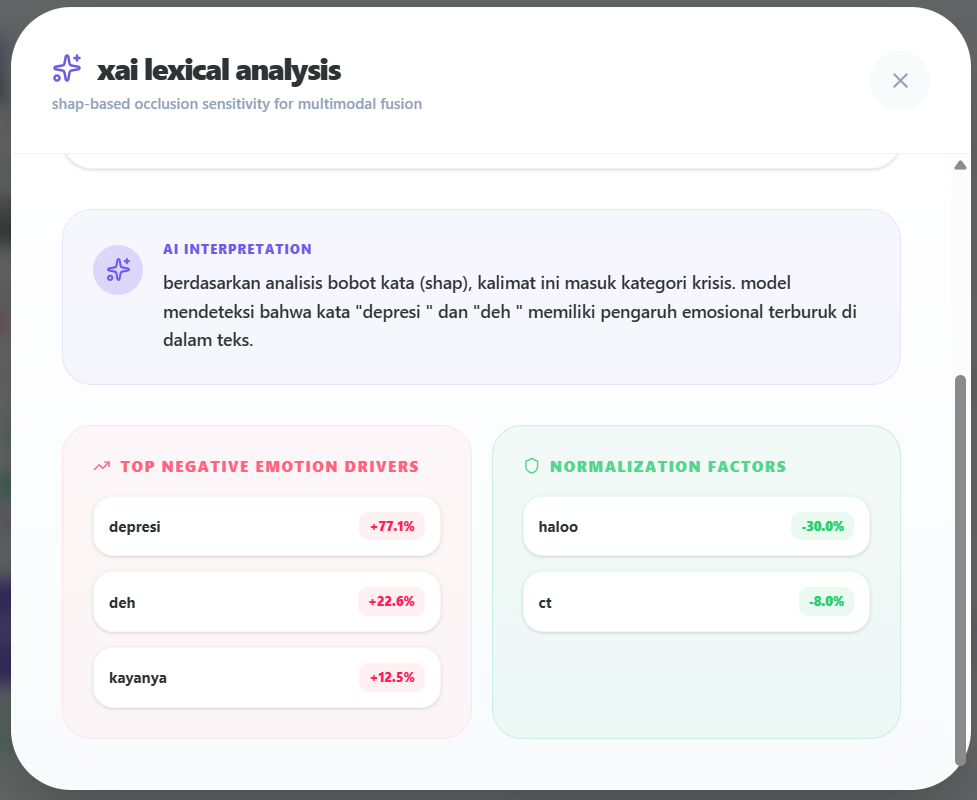
XAI Section
XAI Section
Deep Scan
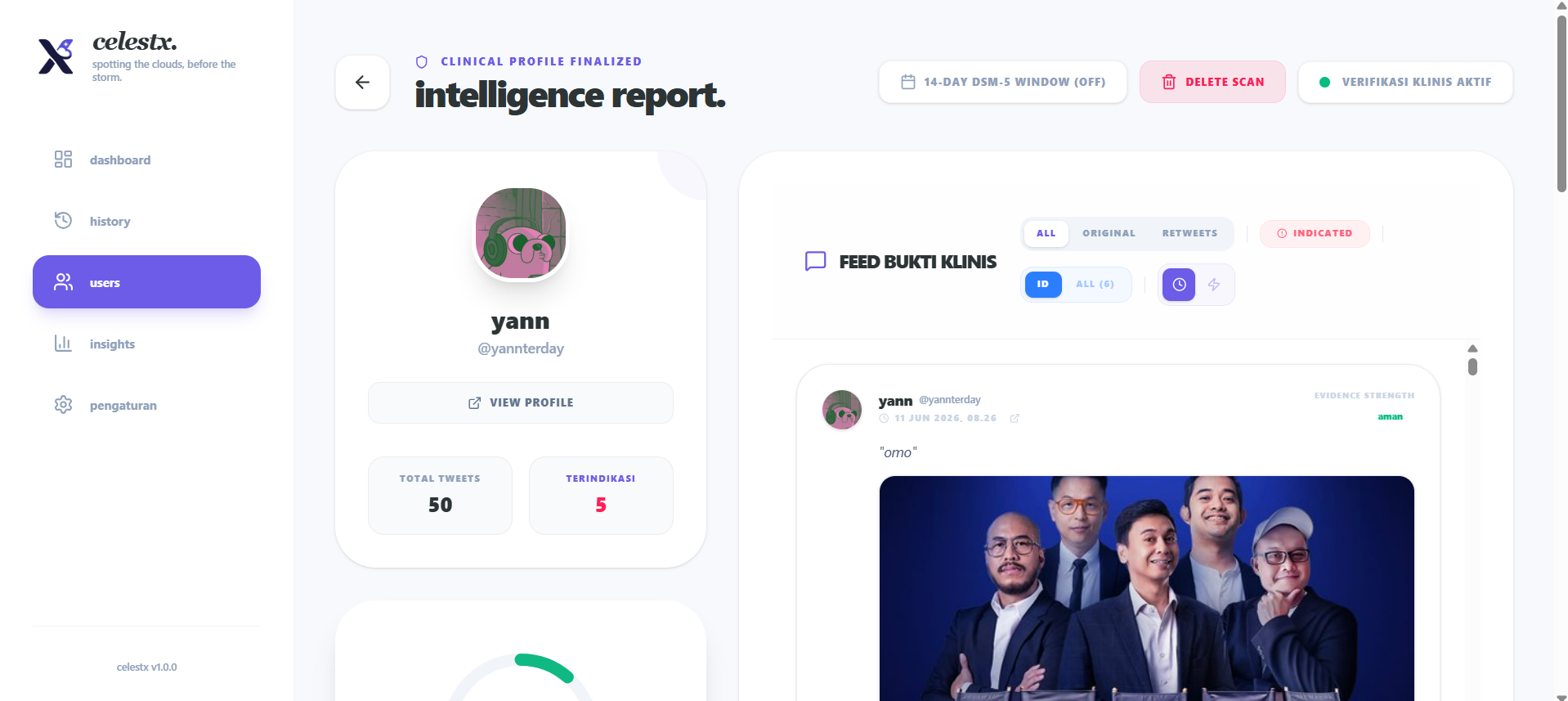
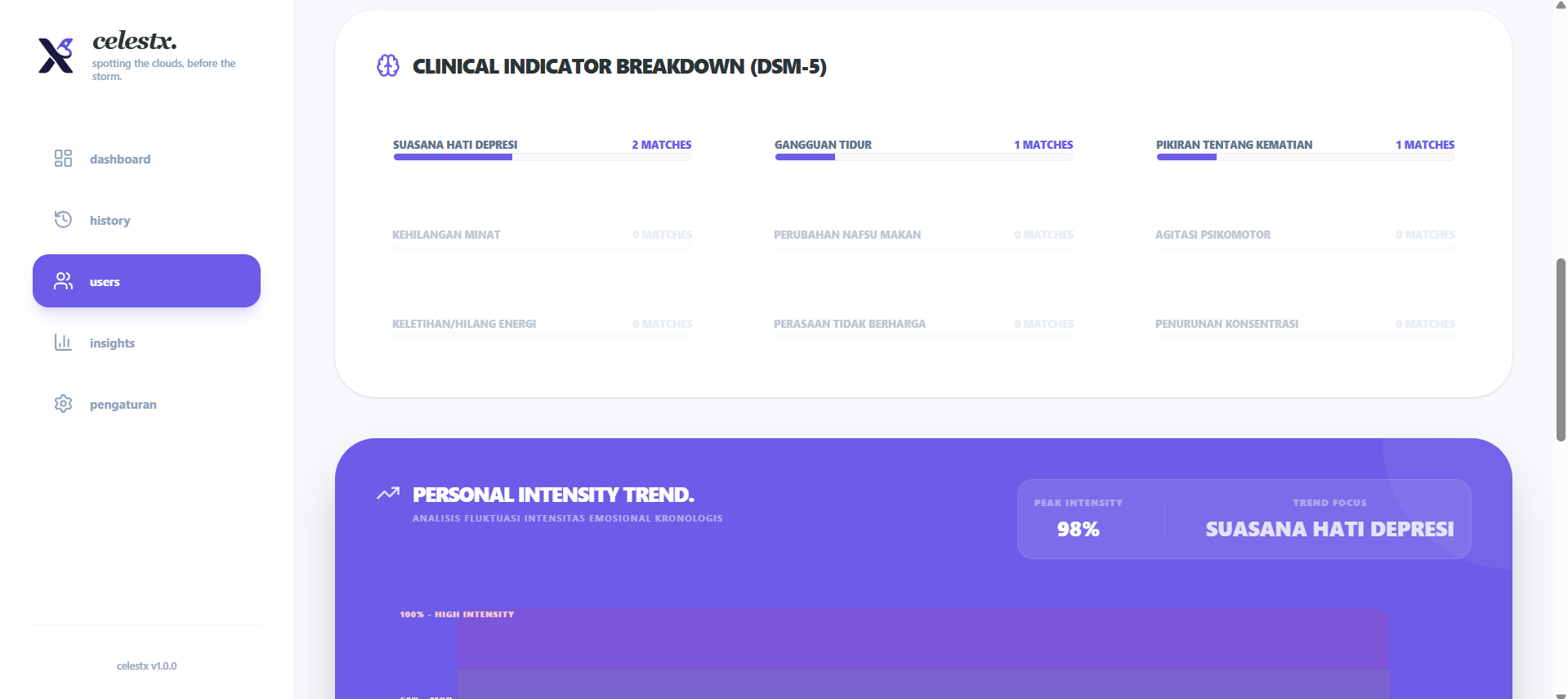
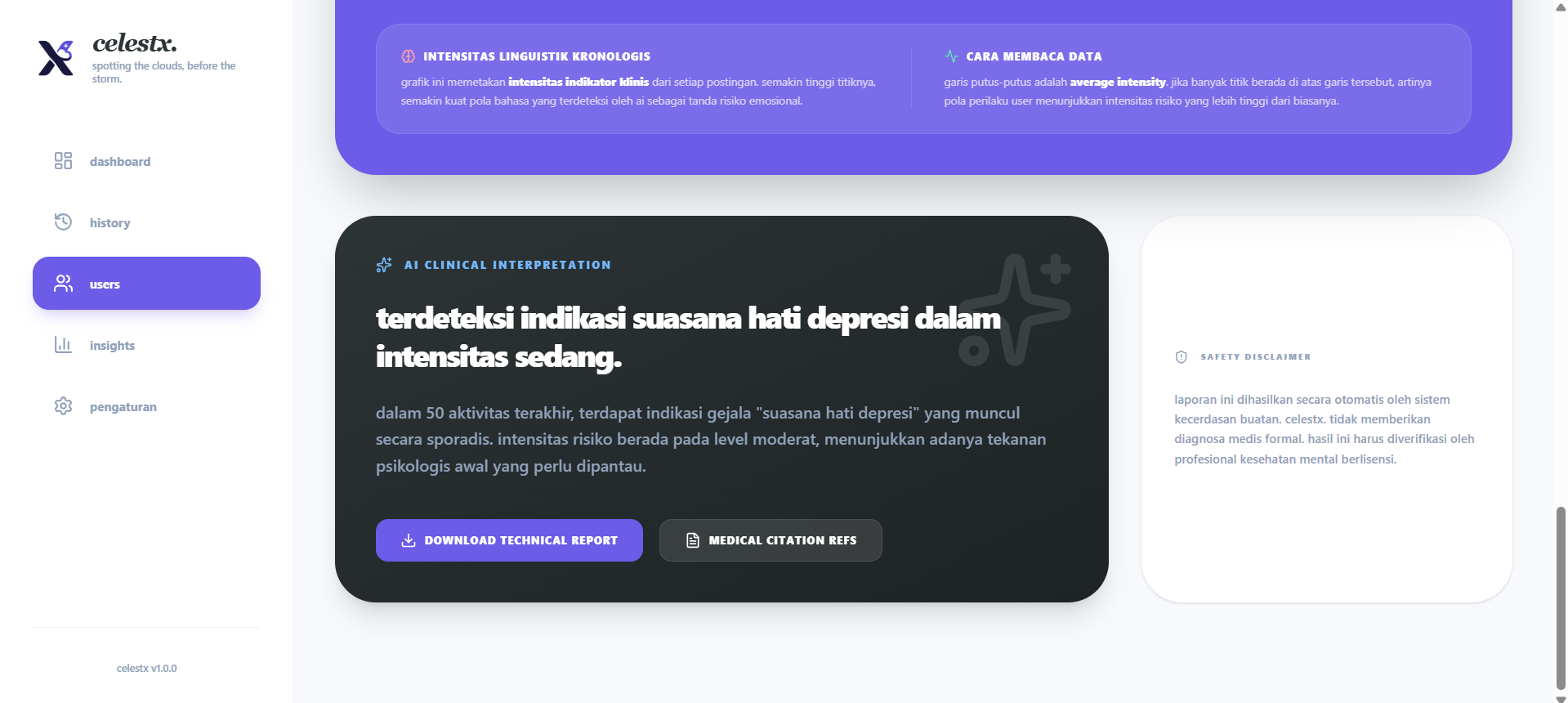
Profile Page
Profile Page
Profile Page

Tech Stack
The brief · problem → approach → result
01 / The problem
Depression signals in Indonesian social media go unnoticed until they escalate. Text-only models miss what images carry, and clinical frameworks rarely make it into the model itself.
02 / The approach
Fuse fine-tuned IndoBERTweet (text) and a Vision Transformer (image) into one risk profile, mapped to 9 DSM-5 symptoms across 3 severity thresholds, explained through SHAP values and ViT attention maps.
03 / The result
A working product end to end: React dashboard, Chrome extension scoring posts in real time, FastAPI inference, Docker deploy. The text model was trained on a balanced 7,991-tweet corpus; the multimodal fusion was evaluated with 5-fold CV on 294 tweet-image pairs, reaching 82.10% accuracy and 79.10% F1 with 13 false negatives out of 294 cases. The first-author paper was presented at ICAICTA 2026.
Two Audiences. One System.
Persona A
Students & General Users
Use CelestX as a digital exposure meter. Track warning signals on your own timeline or that of someone close to you. The Chrome Extension reads text and images on Twitter/X in real time and shows alerts without leaving the platform.
Persona B
Psychologists & Clinicians
CelestX works as a digital phenotyping tool. Collect behavioral signals from a client's social media as a clinical dashboard, a continuous risk archive, and model explanations powered by SHAP and ViT attention maps.
Core Features
Command Center
Central dashboard for monitoring every profile under observation. Real-time risk timeline, threshold notifications, and a DSM-5 category summary on a single screen.
- • Real-time monitoring panel
- • Multi-profile management
- • Threshold alert engine
Archive Vault
A structured repository for every screening result. Comes with SHAP values that pinpoint the words and phrases that drove the decision, and ViT attention maps that highlight the image regions that influenced it.
Insights Hub
Clinical analytics for advanced users: weekly and monthly risk trends, category distribution, coarse demographics (anonymized), and PDF report export for clinical discussions.
DSM-5 Clinical Mapping
9 DSM-5 Symptoms Mapped
- 01Depressed mood
- 02Anhedonia (loss of interest)
- 03Appetite changes
- 04Sleep disturbance
- 05Psychomotor agitation
- 06Fatigue
- 07Feelings of worthlessness
- 08Concentration loss
- 09Suicidal ideation
3-Tier Risk Threshold
STABLE
0-14%
Normal emotional fluctuation. No clinical concern.
MODERATE
15-30%
Early onset of psychological distress. Monitor closely.
HIGH
> 30%
Critical depressive prevalence. Requires professional attention.
Design principle: the system is tuned for high recall. A false positive that gets reviewed by a human beats a false negative that misses a signal entirely.
Research prototype and decision-support concept, not a clinical diagnostic tool.
Technology Architecture
Text
IndoBERTweet fine-tuned
Image
ViT feature extraction
Fusion
late fusion · 1536-d concat
Output
risk score + SHAP + attention map
celestx/
├── backend/                    # python fastapi server
│   ├── main.py                 # api entry point & routing
│   ├── unzip_models.py         # script to combine & extract model files
│   ├── requirements.txt        # backend dependencies
│   └── ...                     # utility scripts
├── dashboard/                  # react (vite) frontend & extension
│   ├── src/                    # react source code
│   │   ├── pages/              # dashboard, history, analysis pages
│   │   ├── components/         # reusable ui components
│   │   └── constants/          # clinical lexicon (dsm-5)
│   ├── manifest.json           # chrome extension manifest v3
│   ├── background.js           # extension background logic
│   └── ...                     # build configurations
└── push.bat                    # deployment utility script